April 19,
2005
Nigeria
studies distinguish USM assistant professor
The
Associated Press
HATTIESBURG — An assistant professor at the University of Southern
Mississippi has been made royalty, but he jokes that he doesn't expect
any special treatment on campus.
Douglas Chambers, who teaches history, has been made a traditional chief
by the descendants of an ancient African civilization after he spent
years researching the eastern Nigerian group.
In March, the Igbo peoples of Nri made him a chief, the first white
person adopted by the royal lineage in its history.
Full Story
THE MONTEATHS OF KEP
:
CONFLUENCE OF IGBO, SCOTS AND CREOLE WORLDS
by
Maureen Warner-Lewis
Literatures in English
University of the West Indies
The biography of Aneaso, later Archibald Monteath, is one of the few
slave narratives so far recovered from the West Indies. Monteath was
neither Moslem, maroon, traveller, nor anti-slavery activist, categories
from which Caribbean slave-narratives have come. His life-story
functioned as a Moravian memoir, a sub-type of the conversion testament.
An Igbo child, kidnapped and shipped to southwestern Jamaica in the
early nineteenth century, he later became a successful fulltime
proselytizer, thus securing his place in the history of the Jamaican
Moravian church and inspiring several dictated accounts of his life.
By close examination of his seven-decade narrative, by probing
textual silences and reticences, by supplementing interpretation with
primary archival data and elaborating these with socio-historical
analyses, the narrative unfolds a geographical, psychological, and
cultural trajectory from pre-colonial Africa, through Scots mercantile
interests, mulatto ascendancy through a caste-ridden plantation economy,
slave uprising in 1831, interaction with German, Irish, English, and
American missionaries, to 1838 slave emancipation and the subsequent
formation of black peasant settlements on estate subdivisions.
The transforming impact on Archibald of literacy, protestant
ideologies, together with church- and plantation-based leadership roles
coexists in the biography with knowledge of his inherited status and
loyalties to Igbo ancestors, thus inviting a nuancing of cultural
content as against signifier of origin in the semantics of terms such as
'African' and 'Creole'.§Part of this paradox is that Archibald realized,
whether by chance or design, the male socio-religious role of the Nri,
the Igbo sub-group to which he belonged.
Released April 15, 2005
Hattiesburg- University
of Southern Mississippi assistant professor of history Dr. Douglas
Chambers says he doesn't expect his colleagues to treat him differently
since he was made royalty by descendants of the king of an ancient
African civilization.
But he admits he would have no qualms with fellow
faculty referring to him as 'Chief Chambers.'
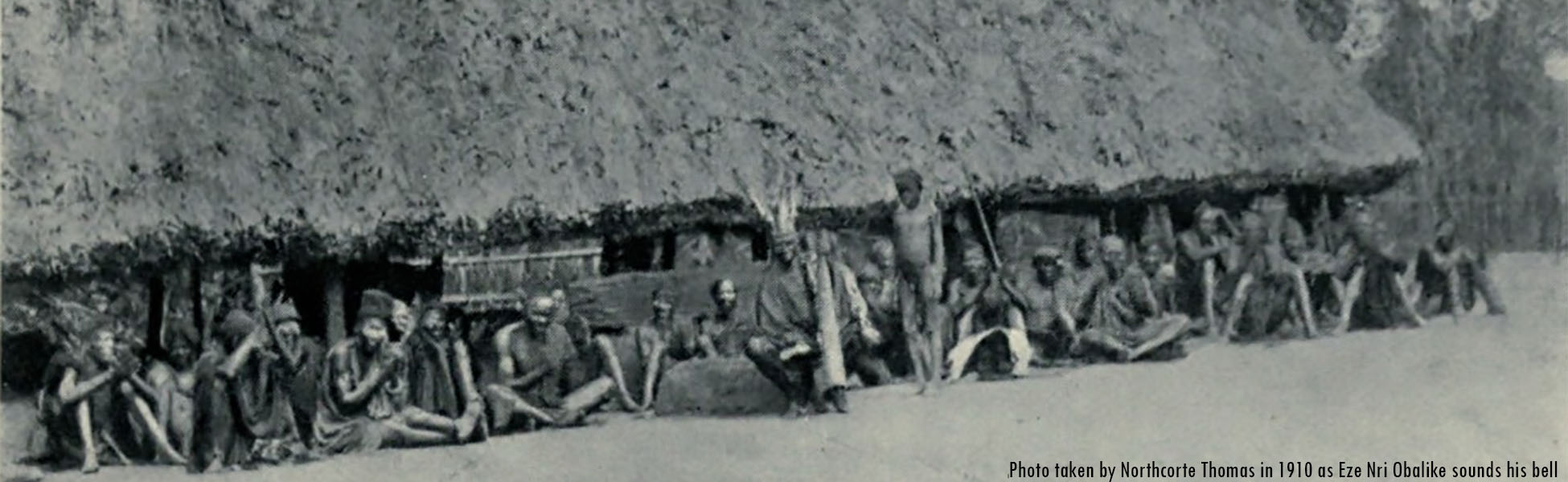
After years of conducting extensive research on the
still living ancient civilization of the Igbo peoples of Nri (Ènrí) in
eastern Nigeria, a traditional chieftainship was bestowed on Chambers in
March by the descendants of the first unified king of the Nri
civilization, the Umu Nri Bùífe, or Umunri of Obeagu.
The Igbo (Ibo) are one of the three principal ethnic
groups of the most populous country in sub-Saharan Africa, and Nri is
the 'Jerusalem' of the Igbo, founded about one thousand years ago.
Full
story